Why Freeze Dried Fruit Bites for Cereal Bars Are Specified Differently Than Snack Formats
Cereal bars present a distinct set of constraints for fruit inclusions. Unlike a standalone snack pack, where fruit pieces are consumed directly from the package, fruit in a cereal bar is embedded within a matrix of grains, binders, syrups, and sometimes coatings. That matrix interacts with the fruit over the entire shelf life of the product. As a result, buyers specifying freeze dried fruit bites for cereal bars tend to focus on moisture control, structural resilience, and compatibility with the bar base rather than on appearance alone.
How Cereal Bar Processing Affects Fruit Inclusion Requirements
During bar production, fruit inclusions are blended with the base, formed under pressure, cut to size, and then packaged. Each step imposes mechanical and environmental stress. Mixing can fracture brittle pieces; forming and cutting can crush or smear fruit; and the surrounding base can donate or absorb moisture over time. In a cereal bar, fruit serves several functional roles: it can act as a moisture sink or source depending on the base, it contributes crispness or chew, and it releases flavor as the bar is eaten. Because the fruit is no longer the primary carrier of the eating experience, specifications often prioritize how the inclusion behaves inside the matrix rather than how it looks on its own.
Key Differences Between Freeze Dried Fruit Bites and Standard Dried Fruit
Freeze drying removes water by sublimation under low pressure, leaving a porous, rigid structure that retains much of the original shape and color. Conventional hot-air drying removes water by evaporation, which tends to collapse cell structure, produce a denser and chewier texture, and concentrate sugars at the surface. In practical terms, freeze dried pieces are lighter in bulk density, more brittle, and rehydrate quickly when exposed to moisture. Standard dried fruit is denser, more pliable, and slower to rehydrate. For cereal bars, this means freeze dried inclusions can deliver a crisp contrast that standard dried fruit cannot, but they are also more sensitive to humidity and mechanical damage during processing.
Grades and Quality Tiers for Freeze Dried Fruit Pieces for Cereal Bars
Grading systems for freeze dried fruit vary by supplier and by fruit type, but most commercial specifications combine visual and functional criteria. Buyers should treat grade as a bundle of attributes rather than a single score, because a piece that looks ideal may still perform poorly in a given bar matrix.
Visual and Structural Grade Criteria
Visual grading typically considers piece form (whole, half, diced, crumbled, or powder), color uniformity, presence of defects such as discoloration or skin fragments, and the proportion of broken or undersized pieces. Uniformity matters because inconsistent piece size can lead to uneven distribution in the bar and inconsistent texture from bite to bite. Structural criteria include firmness, shape retention, and the absence of fines that can cloud the base or create dust during handling. For fruit inclusions in cereal bars, a moderate level of breakage may be acceptable in crumble formats but not in applications where whole or half pieces are a visible feature.
Functional Grade Criteria for Bar Matrices
Functional grading evaluates how the fruit behaves when combined with the bar base. Relevant attributes include resistance to compression during forming, hygroscopicity (the tendency to absorb moisture from the surrounding matrix), and the ability to maintain crispness over the intended shelf life. A fruit piece that is highly hygroscopic may soften prematurely, while an excessively hard piece may not compress with the bar and can create voids or cracks during cutting. Suppliers may describe functional grades in terms of recommended applications, but buyers should verify performance through their own trials rather than relying on category labels alone.
Formats and Particle Size: Matching Fruit Bites to Cereal Bar Applications
Format selection is one of the most consequential decisions in specifying fruit inclusions. The same fruit, processed to different formats, can produce very different bar textures and manufacturing outcomes.
Common Formats and Their Typical Uses
Freeze dried fruit is commonly offered as whole or half pieces, dice, granules, flakes, and powder. Whole and half pieces are used when fruit is a visible, premium feature and the bar structure can accommodate larger inclusions. Dice and granules distribute more evenly and are often chosen for consistent flavor delivery and easier mixing. Flakes and thin slices can layer into the bar or press onto the surface for visual contrast. Powder is typically used for flavoring the base, dusting, or coating rather than as a discrete inclusion. Each format carries trade-offs in cost, handling, and stability.
Particle Size Distribution and Its Impact on Texture and Mixing
Particle size distribution describes the range of piece sizes present in a lot, not just the average. A narrow distribution promotes uniform mixing and predictable texture, while a wide distribution can cause segregation during blending, with fines settling and larger pieces rising. In cereal bars, oversized pieces may interfere with cutting and create weak points, whereas excessive fines can absorb binder and alter the bar's overall texture. Buyers should request a stated distribution range and verify it against trial batches, since the same nominal size can behave differently depending on the fruit and process.
Specifications Buyers Should Verify: Moisture, Water Activity, and Beyond
Specification sheets for freeze dried fruit typically include several parameters that directly affect cereal bar quality. These should be treated as critical-to-quality attributes and verified through incoming inspection.
Freeze Dried Fruit Moisture Content and Water Activity
Moisture content and water activity are related but distinct measures. Moisture content quantifies total water present, while water activity reflects the availability of that water for microbial growth and chemical reactions. In a cereal bar, fruit with high water activity can migrate moisture into the base, softening the bar and potentially reducing shelf life. Low water activity in the fruit helps preserve crispness but can also draw moisture from a high-moisture base. Common test methods include loss-on-drying for moisture content and chilled-mirror or capacitance instruments for water activity. Buyers should specify target ranges and acceptable limits based on their own shelf-life testing.
Additional Specs: Bulk Density, Foreign Matter, and Microbiological Limits
Bulk density affects packaging, dosing, and mixing behavior, and it can vary with piece size and fruit type. Foreign matter controls should cover stones, stems, seeds, and extraneous vegetable material, with defined inspection procedures. Microbiological limits typically address total plate count, yeast and mold, and indicator organisms such as coliforms, with limits set according to the intended market and regulatory framework. Other specifications may include color, flavor, and additive status, depending on the buyer's requirements.
Sourcing Considerations for Cereal Bar Fruit Inclusions
Sourcing freeze dried fruit for cereal bars involves both product specification and supplier qualification. Because fruit is an agricultural input, variability is inherent, and the supplier's process controls determine how much of that variability reaches the finished bar.
Questions to Ask Suppliers About Process and Traceability
A practical supplier review covers raw material origin, fruit variety and harvest window, processing method, and batch traceability. Buyers should ask how the supplier manages incoming fruit quality, how process parameters are monitored, and how lots are segregated and identified. Documentation such as certificates of analysis, safety certifications, and audit reports should be available for review. It is also useful to ask about change notification procedures, since a shift in fruit source or process can alter functional performance.
Packaging, Storage, and Shelf-Life Expectations
Freeze dried fruit is hygroscopic and fragile, so packaging must provide a moisture barrier and mechanical protection. Common formats include food-grade liners in cartons, foil-laminated bags, and rigid containers, often with desiccant or nitrogen flushing for extended storage. Storage conditions should be cool, dry, and away from strong odors, since the porous structure can absorb ambient moisture and aromas. Shelf life depends on packaging, storage, and the fruit itself, and buyers should confirm stated shelf life with their own accelerated or real-time testing.
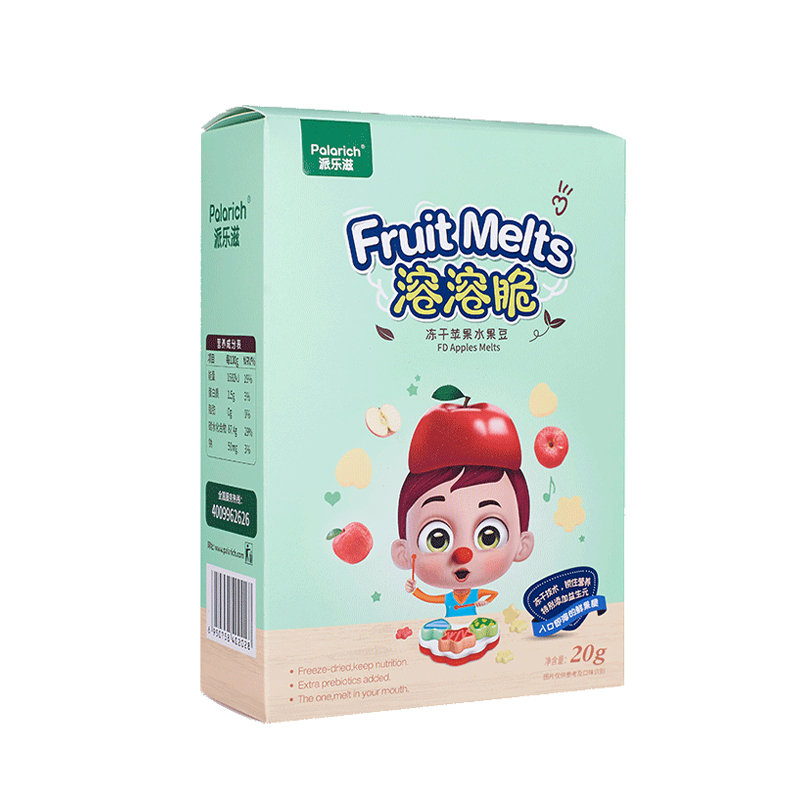
For buyers evaluating specific formats, an example of a commercially available item in this category is Freeze-Dried Apple Fruit Bites.
Public Reference: Example of a Freeze Dried Fruit Supplier's Published Information
The following section summarizes publicly available information from a supplier's own disclosures and is provided for reference only. It is not an endorsement, and buyers should verify all details directly with the company.
Product Range and Processing Technologies Disclosed by Palarich
Palarich's published product information describes a range that includes fruit crisps, chocolate crisps, 3D fruit melts, fruit powder, and functional foods, covering fruits such as apple, strawberry, mango, yellow peach, and grape. The company's fruit crisp line is listed as including freeze dried banana crisps, almond crisps (80g), coconut crisps, and mango crisps (simple packaging, 20g). Palarich states that its core technologies include FD freeze-drying and LMD low-temperature staged dehydration, supported by academician teams and industry-university-research alliances. These details are drawn from the company's public materials and are subject to change.
Official Contact and Source Verification
Buyers seeking to verify Palarich's published information can refer to the company's official website at www.palarich.com and its public contact addresses, service@palarich.com and palarich@palarich.com. Any specification, certification, or capability claim should be confirmed through these official channels before being incorporated into a purchase agreement.
Specifying freeze dried fruit bites for cereal bars is ultimately a matter of matching fruit attributes to a specific bar system. Visual grade, functional grade, format, particle size, moisture, water activity, and microbiological limits all interact, and a change in one parameter can shift performance in another. Buyers who define their requirements clearly, verify them through trials, and qualify suppliers on process control rather than price alone are better positioned to achieve consistent results. Because fruit is a natural material and bar formulations vary widely, the most reliable specifications are those developed and confirmed against the buyer's own product and shelf-life conditions.